


- Share Story
-

-

-

Originally written by Michael Hines · Updated and reviewed by Chaunie Brusie, BSN, RN · Last updated November 2, 2026
Key takeaways
- The main difference: physical therapists (PTs) focus on movement, strength, mobility, and pain, while occupational therapists (OTs) focus on helping people do everyday activities such as dressing, cooking, school, and work.
- Pay is close. In May 2025, PTs earned a median of $102,760 a year, and OTs earned $100,330, according to the Bureau of Labor Statistics (BLS). That’s a gap of $2,430, and both are about double the $50,980 median for all U.S. workers.
- Both occupations are growing much faster than average. The BLS projects 15% job growth for OTs and 12% for PTs from 2025 to 2035, compared with 3% for all occupations.
- Education differs. New PTs need a Doctor of Physical Therapy (DPT) degree. New OTs can enter the field with either a master’s or an entry-level doctoral degree; both are accredited routes under ACOTE’s current standards.
- Both need a national exam and a state license. PTs take the National Physical Therapy Examination (NPTE). OTs take the NBCOT exam to earn the OTR credential.
Physical therapy and occupational therapy are two of the most popular rehabilitation careers in healthcare. Both let you work closely with patients over a series of sessions, build rapport, and see people make real progress.
While physical therapist (PT) and occupational therapist (OT) careers have a lot in common, they differ in their main focus, their degree requirements, and the exams you take to get licensed. Physical therapy focuses on rehabilitating patients for overall movement and after injuries, while occupational therapy focuses on helping patients perform activities of daily life.
This guide compares what PTs and OTs do, where they work, what they earn, and how to become one, so you can choose the path that fits your goals.
>> Browse Physical Therapist Jobs on Vivian
>> Browse Occupational Therapist Jobs on Vivian
Physical therapist vs. occupational therapist: how do they compare at a glance?
| Physical therapist (PT) | Occupational therapist (OT) | |
|---|---|---|
| Main focus | Movement, strength, mobility and pain | Everyday activities (“occupations”) such as self-care, work, school and play |
| Median annual pay (May 2025) | $102,760 ($49.40/hour) | $100,330 ($48.24/hour) |
| Projected job growth, 2025–35 | 12% (much faster than average) | 15% (much faster than average) |
| Average openings per year | About 13,400 | About 10,000 |
| Number of jobs (2025) | 283,700 | 169,600 |
| Entry-level degree | Doctor of Physical Therapy (DPT), typically 3 years | Master’s (MOT/MS/MA) or entry-level doctorate (OTD) |
| Program accreditor | CAPTE | ACOTE |
| National exam | NPTE, administered by FSBPT | NBCOT certification exam (OTR) |
| Interstate compact | PT Compact (privileges active in 38 member states) | OT Compact (enacted in some states; still being rolled out) |
Sources: BLS Occupational Outlook Handbook and OEWS (May 2025 wages; 2025–35 projections); APTA; AOTA; ACOTE; FSBPT; NBCOT; PT Compact Commission; OT Compact Commission.
What is the difference between a physical therapist and an occupational therapist?
Both PTs and OTs help people improve function after an injury, illness, surgery or disability, and both work with patients of all ages. The difference is the goal of treatment.
Physical therapists focus on how the body moves. They work on strength, range of motion, balance, coordination and pain so patients can walk, climb stairs, return to sports or move more comfortably.
Occupational therapists focus on what people need and want to do every day. They help patients relearn or adapt tasks like getting dressed, bathing, cooking, writing or returning to work, and they consider cognitive, emotional and environmental factors as well as physical ones.
As just one example, after a hip replacement, a PT might work on walking and leg strength, while an OT might teach safe ways to put on socks, get in and out of the shower, and set up the home to prevent falls.
What do occupational therapists do?
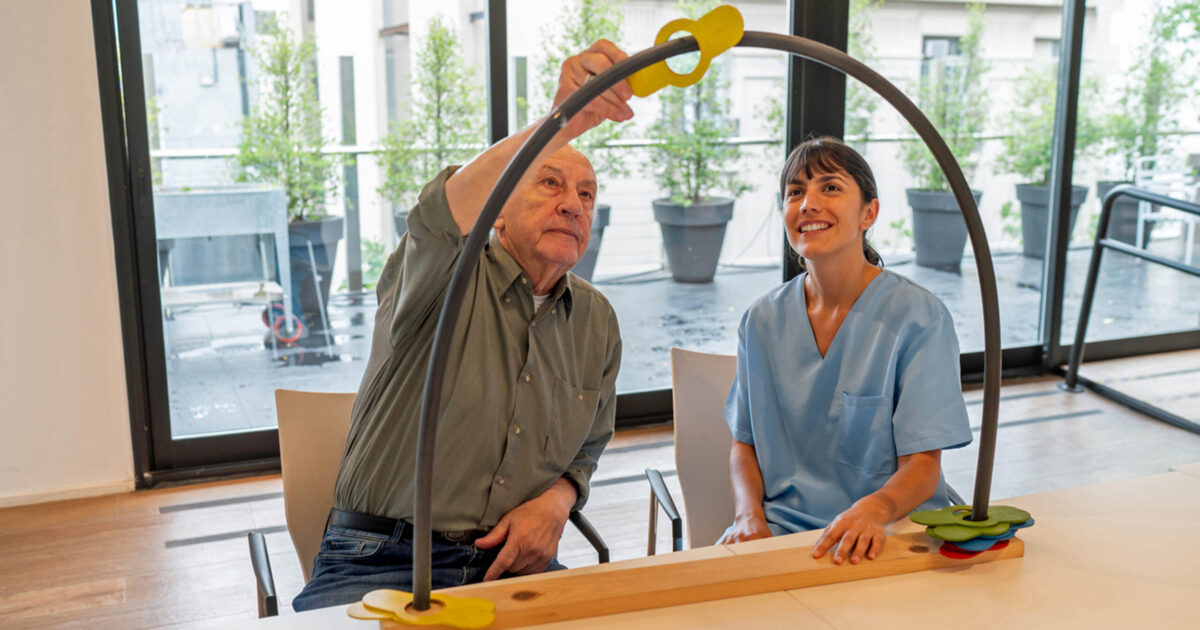
OTs help patients develop, recover, or maintain the skills they need for daily living and work, so they can live as independently as possible or function to the best of their ability. Typical responsibilities include:
- Evaluating a patient’s needs and developing an individualized treatment plan
- Teaching patients how to do daily tasks, such as dressing, cooking or working, sometimes in a new way
- Recommending changes to the home, school or workplace to make tasks safer and easier
- Recommending and training patients to use adaptive equipment and technology
- Working with people who have developmental disabilities, mental health conditions, cognitive changes, or physical impairments
What do physical therapists do?

PTs examine, diagnose, and treat movement problems to improve mobility and help manage pain. (It is important to note here that physical therapists only diagnose movement-related dysfunctions, and they do not make medical diagnoses.)
Typical PT responsibilities include:
- Examining patients’ movement and physical abilities and developing a plan of care
- Using exercise and other therapies to improve mobility, strength and coordination, ease pain and help prevent further injury
- Using hands-on techniques such as manual therapy and stretching
- Teaching patients and families about home exercise, injury prevention and staying active
- Treating musculoskeletal, neurological, cardiovascular and pulmonary conditions
Where do physical therapists and occupational therapists work?
PTs and OTs work in many of the same places: hospitals, outpatient clinics and therapy offices, skilled nursing facilities, home health agencies and schools. They often work alongside speech-language pathologists as part of a rehabilitation team.
OTs are also common in schools and mental health settings, and some OTs and PTs consult with employers on workplace safety and ergonomics. Most PTs and OTs work full time and in person. Some work evenings or weekends to fit patients’ schedules.
Both roles involve hands-on patient care: demonstrating techniques and exercises, then guiding patients as they practice. Both are often supported by assistants.
Physical therapist assistants need an associate degree from an accredited program, and occupational therapy assistants can train through an associate or bachelor’s degree program. In May 2025, PT assistants earned a median of $68,380 and OT assistants $72,300, according to BLS OEWS data.
What degree do you need to be a physical therapist vs. an occupational therapist?
Both careers require a graduate degree from an accredited program, a passing score on a national exam, and a state license. Here’s how the requirements compare.
| Requirement | Physical therapist | Occupational therapist |
|---|---|---|
| Degree | Doctor of Physical Therapy (DPT) from a CAPTE-accredited program | Entry-level master’s or doctoral degree from an ACOTE-accredited program |
| Typical program length | 3 years | Master’s: 2 to 3 years; doctoral programs run longer |
| Before you apply | Usually a bachelor’s degree plus prerequisites such as anatomy, chemistry and physics | Usually a bachelor’s degree plus prerequisites such as biology and psychology |
| Clinical training | Clinical education is about 23% of the DPT curriculum; the final clinical experience averages 22 weeks | At least 24 weeks of full-time Level II fieldwork; doctoral students also complete a 14-week capstone |
| National exam | NPTE (some states also require a jurisprudence exam) | NBCOT exam; passing earns the OTR credential |
| License | Required in all states | Required in all states, DC, Puerto Rico and Guam |
| Keeping your license | Continuing education is typically required for renewal | Continuing education is typically required for renewal; NBCOT certification renews every 3 years |
Occupational therapist requirements
- Degree: OTs can enter the profession with either a master’s degree (such as an MOT, MS or MA) or an entry-level doctorate (OTD). The Accreditation Council for Occupational Therapy Education (ACOTE) accredits both. Its current 2023 Standards, in effect since July 31, 2025, include separate standards for master’s and doctoral OT programs, so the master’s degree remains a valid route into the field. According to AOTA, the doctoral degree adds coursework in areas like research, leadership and advocacy, plus a 14-week capstone.
- Prerequisites: Most programs require a bachelor’s degree, which doesn’t have to be in a specific subject, plus coursework in biology, psychology and other sciences. Some also ask for observation or volunteer hours.
- Exam and credential: Graduates take the National Board for Certification in Occupational Therapy (NBCOT) exam. Passing it lets you use the Occupational Therapist Registered (OTR) credential.
- License: Every state requires OTs to be licensed. Requirements vary, so check with your state’s OT regulatory board.
- Continuing education: States set their own requirements to renew a license. NBCOT certification renews every three years with 36 renewal units.
Physical therapist requirements
- Degree: To practice in the U.S., PTs need a Doctor of Physical Therapy (DPT) degree from a program accredited by the Commission on Accreditation in Physical Therapy Education (CAPTE). DPT programs typically take three years after your undergraduate degree is completed.
- Prerequisites: Most programs require a bachelor’s degree and courses such as anatomy, chemistry and physics. Some schools offer 3+3 or freshman-entry formats.
- Exam: Graduates take the National Physical Therapy Examination (NPTE), administered by the Federation of State Boards of Physical Therapy (FSBPT). Some states also require a jurisprudence (law) exam or a background check.
- License: Every state requires PTs to be licensed. See Vivian’s guide to physical therapist licensing requirements by state.
- Continuing education: Typically required to renew a license. Some PTs also complete a residency (usually about a year) or fellowship after graduation.
What specialties and certifications can PTs and OTs earn?

Once licensed, PTs and OTs can practice as generalists. Many build expertise in a specific area as they gain experience, and some earn a board certification to show it. Certification is optional; it isn’t required to work in a specialty area. Browse more on Vivian’s certification guides.
Occupational therapy specialties
- Pediatrics: Helping children build fine motor, sensory, and self-care skills for school and play
- Gerontology: Helping older adults stay independent and safe at home
- Physical rehabilitation: Helping patients recover function after injury, stroke or surgery
- Mental health: Supporting people with mental health conditions in daily routines and roles
- Hand therapy: Rehabilitation of the hand and upper limb
- Ergonomics: Improving workplace design and habits to help prevent injuries
The American Occupational Therapy Association (AOTA) currently offers advanced board certification in three areas: gerontology (BCG), pediatrics (BCP), and physical rehabilitation (BCPR).
OTs and PTs can also become Certified Hand Therapists (CHT) through the Hand Therapy Certification Commission, which requires at least three years of clinical experience, including 4,000 or more hours in direct hand therapy practice, and a passing score on its exam.
Physical therapy specialties
- Orthopaedics: Treating musculoskeletal injuries and conditions
- Neurology: Working with people who have conditions such as stroke, Parkinson’s disease and multiple sclerosis
- Pediatrics: Addressing movement and development in children
- Sports: Injury prevention and recovery for athletes
- Cardiovascular and pulmonary: Helping patients with heart and lung conditions improve endurance and function
- Geriatrics: Focusing on mobility, balance and fall prevention in older adults
The American Board of Physical Therapy Specialties (ABPTS), which runs APTA’s specialist certification program, certifies PTs in 10 specialty areas. Applicants generally need at least 2,000 hours of clinical practice in the specialty (or a related residency) and must pass an exam.
The 10 areas are:
- Cardiovascular and pulmonary
- Clinical electrophysiology
- Geriatrics
- Neurology
- Oncology
- Orthopaedics
- Pediatrics
- Pelvic and women’s health
- Sports
- Wound management
Do physical therapists or occupational therapists make more money?

PTs earn slightly more. According to BLS Occupational Employment and Wage Statistics (OEWS) data for May 2025:
| Pay measure (May 2025) | Physical therapists | Occupational therapists |
|---|---|---|
| Median annual wage | $102,760 | $100,330 |
| Median hourly wage | $49.40 | $48.24 |
| Mean (average) annual wage | $105,280 | $101,280 |
| Lowest 10% earned less than | $77,140 | $71,690 |
| Highest 10% earned more than | $135,140 | $131,950 |
Source: BLS OEWS, May 2025. The median wage for all U.S. occupations was $50,980.
Which work settings pay PTs and OTs the most?
For both careers, home healthcare services had the highest median pay among the top industries the BLS reports.
| Work setting (May 2025 median) | Physical therapists | Occupational therapists |
|---|---|---|
| Home healthcare services | $114,740 | $106,300 |
| Nursing and residential care facilities (PT) / skilled nursing facilities (OT) | $110,460 | $105,850 |
| Hospitals | $106,800 | $102,820 |
| Offices of physical, occupational and speech therapists, and audiologists | $97,160 | $97,940 |
| Educational services | Not reported | $87,300 |
Source: BLS Occupational Outlook Handbook, pay tab for each occupation.
Pay also varies by state, metro area, experience and specialty. To see what employers are offering right now, check Vivian’s physical therapist salary and occupational therapist salary pages, which are based on current job postings, along with pay for travel PT and travel OT roles.
For more ideas, read how physical therapists can earn more money.
What is the job outlook for physical therapists and occupational therapists?
Both careers are in demand. The BLS projects employment of occupational therapists will grow 15% and employment of physical therapists will grow 12% from 2025 to 2035, both much faster than the 3% average for all occupations.
- PTs: about 33,800 new jobs over the decade and about 13,400 openings a year on average
- OTs: about 25,200 new jobs over the decade and about 10,000 openings a year on average
Much of the demand comes from a growing older adult population, who are more likely to need rehabilitation after strokes, heart attacks, falls, and other conditions. Many openings will also come from therapists who retire or change careers.
Explore open physical therapist jobs and occupational therapist jobs on Vivian, including travel PT and travel OT roles.
Can PTs and OTs work in other states with one license?
Interstate compacts make it easier to practice in more than one state, which can help travel therapists. Instead of getting a full license in each state, you buy a “compact privilege” to practice in another member state.
- PT Compact: As of October 2026, 38 member states are actively issuing and accepting compact privileges, and three more have enacted the compact but aren’t issuing privileges yet. See the current PT Compact map and Vivian’s guide to the PT Compact.
- OT Compact: The Occupational Therapy Licensure Compact has been enacted in a number of states but isn’t fully up and running. Each member state opens privilege applications on its own timeline. Learn more in Vivian’s guide to what the OT Compact means for OTs.
PT vs. OT: what are the key similarities and differences?

Key similarities
- Patient-centered care: Both create individualized treatment plans and work hands-on with patients.
- Focus on rehabilitation: Both help patients recover function and independence.
- Teamwork: Both work closely with physicians, nurses, speech-language pathologists and other providers.
- Education and licensure: Both require a graduate degree, a national exam, and a state license.
- Strong pay and demand: Both have median pay about twice the median for all U.S. workers, much faster-than-average projected growth, and travel options.
Key differences
| Occupational therapists | Physical therapists | |
|---|---|---|
| Focus | Daily activities and independence: dressing, bathing, cooking, school, work | Physical function: mobility, strength, balance and pain |
| Typical techniques | Task training, adaptive equipment, home and workplace modifications, cognitive and sensory strategies | Therapeutic exercise, manual therapy, stretching, gait and balance training |
| Example | Teaching someone with a hand injury new ways to use utensils, or helping a child with developmental delays build play skills | Helping a patient walk again after surgery, or teaching exercises to prevent sports injuries |
| Common specialties | Pediatrics, gerontology, physical rehabilitation, mental health, hand therapy | Orthopaedics, neurology, sports, cardiovascular and pulmonary, pediatrics, geriatrics |
| Entry-level degree | Master’s or doctorate | Doctorate (DPT) |
How we got this data
Pay figures come from the BLS Occupational Employment and Wage Statistics (OEWS) national estimates for May 2025, the most recent available, for physical therapists (SOC 29-1123), occupational therapists (29-1122), physical therapist assistants (31-2021) and occupational therapy assistants (31-2011). Job counts, projections and pay by work setting come from the BLS Occupational Outlook Handbook, which uses 2025–35 projections.
The $2,430 pay gap is the difference between the two May 2025 medians. Education, exam and certification details come from the official accrediting, testing and certifying organizations listed in the Sources section. Medians are pre-tax and don’t adjust for cost of living.
Frequently asked questions about physical therapy vs. occupational therapy
Which is better, physical therapy or occupational therapy?
Neither is better overall. The right choice depends on what you enjoy. If you’re drawn to exercise, movement, and sports, physical therapy may fit. If you like problem-solving around daily tasks, mental health, and adapting environments, consider occupational therapy. Pay and job growth are similar for both, and both can be highly rewarding career options.
Who makes more, a PT or an OT?
Physical therapists earn slightly more. In May 2025, the median annual wage was $102,760 for PTs and $100,330 for OTs, a difference of $2,430, according to the BLS. For both careers, home healthcare services had the highest median pay among the top work settings the BLS reports.
Is it harder to become a PT or an OT?
Both are demanding, but the education paths differ. PTs must earn a three-year Doctor of Physical Therapy degree. OTs can enter the field with a master’s degree, which typically takes two to three years, or with an entry-level doctorate. Both must pass a national exam and get a state license.
Do occupational therapists need a doctorate now?
No. Under ACOTE’s 2023 Standards, in effect since July 31, 2025, both master’s and entry-level doctoral programs are accredited routes into the profession. Graduates of either can take the NBCOT exam and apply for a state license. Doctoral programs add advanced coursework and a 14-week capstone experience.
Which career is growing faster, OT or PT?
Occupational therapy is projected to grow slightly faster. The BLS projects 15% growth for OTs and 12% for PTs from 2025 to 2035, compared with 3% for all occupations. In raw numbers, PTs are projected to have more openings each year: about 13,400, versus about 10,000 for OTs.
Can a PT become an OT, or vice versa?
Not without going back to school. Each profession requires a degree from its own accredited program and a passing score on its own national exam. Some prerequisite courses overlap, so check with the program you’re interested in. One credential both PTs and OTs can earn is Certified Hand Therapist (CHT), after meeting its experience requirements.
Can PTs and OTs work as travel therapists?
Yes. Both PTs and OTs take travel contracts. The PT Compact lets PTs buy privileges to practice in other member states, with 38 states actively issuing and accepting them. The OT Compact has been enacted in a number of states but is still being rolled out, so OTs should check each state’s status and may still need a separate license.
Find physical and occupational therapy jobs
Vivian Health can help you find staff and travel jobs in physical therapy, occupational therapy and other allied health careers. Use our job search tool to sort jobs by location, specialty and contract type, or see the highest-paying allied health specialties.
>> Browse Physical Therapist Jobs on Vivian
>> Browse Occupational Therapist Jobs on Vivian
Sources
- U.S. Bureau of Labor Statistics, Occupational Employment and Wage Statistics, May 2025 (national estimates)
- U.S. Bureau of Labor Statistics, Occupational Outlook Handbook: Physical Therapists
- U.S. Bureau of Labor Statistics, Occupational Outlook Handbook: Occupational Therapists
- American Physical Therapy Association, Becoming a Physical Therapist
- Commission on Accreditation in Physical Therapy Education, CAPTE
- Federation of State Boards of Physical Therapy, Exam Candidates
- American Board of Physical Therapy Specialties, APTA Specialist Certification
- Accreditation Council for Occupational Therapy Education, 2023 ACOTE Standards
- American Occupational Therapy Association, Become an Occupational Therapy Practitioner and Advanced Certification
- National Board for Certification in Occupational Therapy, Certification Renewal
- Hand Therapy Certification Commission, The CHT Credential
- Physical Therapy Compact Commission, PT Compact Map
- Occupational Therapy Compact Commission, OT Compact
2026 update by Vivian Health.