


- Share Story
-

-

-

Working legally in any state requires a state-specific nursing license, whether you’re a registered nurse (RN) or licensed practical/vocational nurse (LPN/LVN). Experienced or new travel nurses who can’t obtain a multistate license must get a single-state RN or LPN/LVN license before starting each new assignment, which can involve significant paperwork and planning. Use these practical tips to tackle the process and reduce the stress of securing single-state licensure wherever you roam.
Travel Nursing and Single-State Nursing License Requirements
Travel nursing offers an exciting chance to explore new places, earn great pay and continue doing what you love. It often comes with higher nurse salaries compared to staff roles, and if you can duplicate housing expenses, you can receive a tax-free stipend that boosts your take-home pay. Travel nursing also helps expand your career and introduces you to new opportunities and people along the way.
Compact Licenses vs. Single-State Licenses
For travel nurses, a compact license through the Enhanced Nurse Licensure Compact (eNLC) offers significant advantages over a single-state license. Nurses whose primary state of residence (PSOR) is one of the 38 eNLC states that have fully implemented the Compact can apply for a compact license to work in any other eNLC state without additional nursing licensure (except in Connecticut and Massachusetts, where implementation was still pending as of December 2024). This flexibility is a game-changer for travel nurses, simplifying last-minute assignments and multistate opportunities.
Qualifying for a Compact License
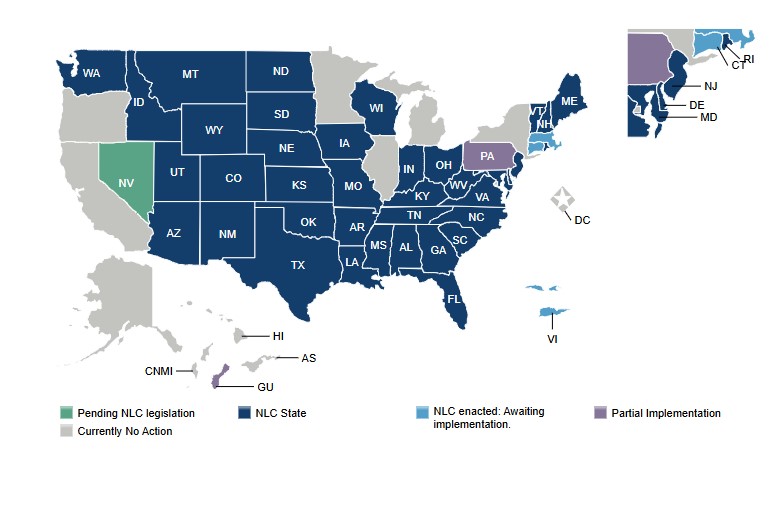
Source: National Council of State Boards of Nursing
You must permanently reside in an eNLC state, declare this state your PSOR and meet the 11 uniform licensure requirements to qualify for a Compact license, also called a multistate license. Nurses who meet all criteria can apply for a Compact license through their state’s Board of Nursing (BON).
Unfortunately, international nurses and those whose primary residence isn’t an eNLC state aren’t eligible for Compact licensure. In these cases, nurses must apply for single-state licenses for each state they plan to work in. If you hold a Compact license but will be practicing in a non-Compact state, you must still obtain a single-state license.
RELATED: Understanding Travel Nurse Residency Rules
Limitations of Single-State Licenses
Single-state licenses may feel restrictive, as they limit you to practicing in the state where you’re licensed. For travel nurses, this means extra paperwork, more time spent on licensure applications and limited flexibility. But don’t stress. It’s nothing a little advanced planning can’t handle. The rest of this article is focused on single-state nursing licensure tips to help you understand the process.
How to Get a Single-State Nursing License
Each state has different prerequisites and processes for getting a nursing license. Some states’ applications are only online, others still have paper applications and a few allow you to walk into the BON office to apply. However, sometimes, you must submit specific documentation before your in-person visit. Make sure you double-check the requirements to ensure you’ve fulfilled them all to expedite the process. Typically, if your application isn’t complete, it won’t be processed, and this will cause delays.
Navigating the complexities of single-state nursing licenses is crucial for travel nurses aiming to work across multiple states without getting sidelined by missing licensure. Understanding the associated costs, timing and required documentation can streamline the process and prevent potential setbacks.
Required Documentation for Travel Nurses
Travel nurses must provide various documents when applying for licenses in different states. Common requirements include:
- Proof of Identity: A state-issued driver’s license or an international passport with a name matching your application
- Educational Transcripts: Official transcripts from your nursing program
- License Verification: Verification of your original nursing license and current license(s)
- Background Checks: Completion of state and federal background checks, often requiring fingerprints
- Proof of Citizenship or Legal Residency: Documentation such as a U.S. birth certificate or passport, unexpired visa or permanent resident card
- Social Security Number: May need Social Security Number or Individual Tax Identification Number
Some states may also require proof of English proficiency for non-native speakers and a record of addresses for the past seven years if you haven’t lived at your current address for that duration. Given the variability in requirements, it’s advisable to consult the specific BON for each state where you intend to practice.
By meticulously managing these aspects, travel nurses can effectively coordinate their licensure with job opportunities, ensuring a smoother transition between assignments.
RELATED: 8 Steps Canadian Nurses Must Take to Work in the U.S.
Travel Nursing Info on Background Checks and Fingerprinting

Each state has unique background checks and fingerprinting requirements, so it’s essential to research and plan accordingly. While nearly all states require a background check, the processing time varies. Most states also require fingerprints, taken digitally or on a hard copy card.
When submitting fingerprints, follow your state BON’s guidelines closely. If hard copy cards are needed, confirm whether you need an FBI or Department of Health card and request it directly from the board or other appropriate provider to avoid mistakes. Digital fingerprints are usually preferred as they’re processed faster and have lower rejection rates.
For digital fingerprints, you must use a state-approved agency and obtain a processing code from the BON. Some states don’t allow out-of-state applicants to use digital services, so you may need to submit hard-copy cards instead. In this case, visiting a local police station for fingerprinting increases the likelihood of acceptance due to their expertise.
If you choose a fingerprinting agency, check their services and fees in advance. Many digital fingerprint locations can also process hard-copy cards. Proper preparation and attention to detail help ensure a smooth process and prevent delays in your licensure.
Timing Your Licensure with Potential Travel Nursing Jobs
Digital fingerprints and background checks are typically valid for about 60 days. Therefore, completing the state nurse licensure application within this period is crucial to avoid repeating steps and paying for something more than once. Visit Vivian Health’s nurse licensure pages to learn specific requirements in each state and to help you better time your licensure.
Besides timing your licensure, you must also be mindful of specific state renewal rules. For example, Colorado RN licenses expire on September 30 every two years. However, obtaining a license within 120 days before this date exempts you from immediate reapplication. Another thing to remember is that some states follow your birthdate for renewal while others go by the calendar year, so be sure to check this detail. Continuing education is often a requirement for renewal, which is one more thing you must keep track of to ensure a single-state license doesn’t lapse when needed for an upcoming assignment.
RELATED: Continuing Education Requirements for RN Licensure Renewal by State
Costs Involved with Multiple Licenses
Obtaining and maintaining multiple nursing licenses can be costly, and fees can vary widely by state. For example, Arkansas charges $125 for a permanent license, while Alaska’s fee is $375. Additional costs often include background checks and fingerprinting, typically ranging from $50 to $100. If you need a temporary permit to start working before your permanent license is issued, you usually face additional fees for that as well.
Travel nursing agencies may help offset these costs. Many offer reimbursement for licensure expenses, but usually only if you need the license for an assignment. Before signing a contract, ask about their policies on covering application fees, fingerprinting costs or other related expenses. Some agencies also assist with the application process, helping gather documentation and navigate requirements to save you time and stress.
Planning ahead is key to managing the expenses you must cover. Research the requirements for each state where you plan to work and budget for fees upfront. Submit complete applications early to help you avoid costly delays, such as needing a temporary license. By staying organized and leveraging agency support, you can handle licensure costs more efficiently and keep your focus on advancing your travel nursing career.
RELATED: Take the Quiz: Is Travel Nursing Right for You?

Fast-Track Your Career with a Temporary Nurse License
Temporary nursing licenses can significantly reduce the time it takes to start working in a new state. These licenses are typically issued within a few days or weeks, allowing travel nurses to begin assignments while waiting for their permanent license to be approved. While temporary licenses are usually valid for a short period of 6 months or less, they provide a critical window to get settled and meet state-specific requirements for permanent licensure.
Why Temporary Licenses Are Helpful
Temporary licenses are especially valuable for travel nurses facing tight deadlines between assignments or when unexpected opportunities arise. They allow you to avoid lengthy processing times for permanent licenses and ensure there isn’t any delay in starting work.
For states offering temporary licenses, the process is often straightforward and requires fewer steps than applying for a permanent license. You generally need to:\
- Submit an online or paper application for the temporary license
- Provide proof of your existing nursing license in good standing
- Complete any required background checks or fingerprinting
3 Tips for a Smooth Temporary RN License Process
- Start Early: Although temporary licenses are processed quickly, it’s still important to begin your application as soon as you know your assignment location.
- Check State Requirements: Each state’s BON has specific documentation requirements, such as proof of identity, transcripts or license verification. Ensure you have these ready to avoid delays.
- Know the Expiration Date: Temporary licenses typically expire after 3–6 months. Use this time to complete your permanent licensure application if needed.
States Offering Temporary Licenses
Many states offer temporary licenses to both new graduates and nurses already licensed in another state. However, some states, like Florida, only offer temporary licenses for nurse graduates while passing the National Council Licensure Examination (NCLEX). These permits allow them to practice under the direct supervision of a licensed RN and immediately expire if they fail the NCLEX. Other states, like Hawaii, don’t offer temporary permits for nurse graduates but offer them to licensed RNs who apply for full licensure.
Temporary licenses are a fantastic tool to keep your travel nursing career moving without unnecessary delays. With proper preparation, you can take full advantage of this option and seamlessly transition to your next assignment.
Stay Organized While You Apply for Travel Nurse Licenses
Staying organized is key to managing multiple single-state nursing licenses. Create a checklist for each state, outlining required documents and deadlines. Most BONs offer online resources under “licensure by endorsement” to simplify the process.
Use tools like Google Calendar or a planner to track deadlines and apps like Dropbox or Google Drive to store and access important documents. Completing a Vivian Reusable Profile provides a convenient way to digitize your documentation and flags expired documents, such as state RN licenses. Always keep your filing system consistent between digital and physical formats, and keep a few hard copies of key records on hand for facilities requiring them.
Simplify Single-State Nursing Licenses
Navigating single-state nursing licenses doesn’t have to be overwhelming. With careful planning, proper organization and the right tools, you can streamline the process and focus on what matters most—advancing your travel nursing career. Whether it’s understanding state requirements, leveraging agency support or taking advantage of temporary licenses, staying proactive can help you easily tackle licensure challenges.
Create a free Vivian account to start your next travel nursing adventure and explore assignments tailored to your goals today.