


- Share Story
-

-

-

Originally written by Katherine Brown · Updated and reviewed by Chaunie Brusie, BSN, RN · Last updated November 2, 2026
Key takeaways
- If speed is your goal, the fastest healthcare career path takes about 1 year: practical LPN/LVN programs typically take about a year, and medical assistant programs take about 1 to 2 years, according to the Bureau of Labor Statistics (BLS).
- The longest path is becoming a physician: A bachelor’s degree, 4 years of medical school, and 3 to 9 years of residency, or roughly 11 to 17 years after high school.
- Physicians and surgeons earn the most, with a median annual wage of $275,930 in May 2025. Registered nurses earned a median of $97,550.
- Six of these seven paths lead to jobs that pay more than the $50,980 median for all U.S. workers. Medical assistants, at $45,690, are the exception.
- Nurse practitioners have the fastest projected growth of these jobs, at 41% from 2025 to 2035, followed by health information technologists (16%) and medical assistants (13%). Registered nursing has the most openings, about 180,800 a year.
Demand for healthcare workers keeps climbing. The BLS projects about 1.9 million openings a year in healthcare occupations from 2025 to 2035, and overall healthcare employment is expected to grow much faster than the average for all occupations. An aging population is one reason: 1 in 6 people in the U.S. were 65 or older in 2020, according to the Census Bureau. The Association of American Medical Colleges (AAMC) projects a shortage of up to 86,000 physicians by 2036.
Some healthcare careers take more than a decade of training. Others take a year or two. Below, Vivian Health compares how long seven common healthcare education paths take, what you typically need to start, what licensing or certification is involved, and what the jobs they lead to pay.
How long does each healthcare degree take, and what does it pay?
| Program | Typical time to complete | Typical job | Median annual pay (May 2025) | Projected job growth, 2025–35 |
|---|---|---|---|---|
| Medical degree (MD or DO) | 4 years after a bachelor’s, plus 3–9 years of residency | Physician or surgeon | $275,930 | 4% |
| Nursing diploma, ADN or BSN | 1–3 years (diploma), 2–3 years (ADN) or 4–5 years (BSN) | Registered nurse | $97,550 | 6% |
| Nurse practitioner (NP) | About 6 to 8 years total (4 years for a BSN, then 2 to 4 years of graduate study) | Nurse practitioner; can specialize | $132,300 | 41% |
| Radiologic technology (associate or bachelor’s) | About 2 years (associate) to 4 years (bachelor’s) | Radiologic technologist | $80,110 | 5% |
| Health information (certificate or associate) | Under 1 year to about 2 years | Medical records specialist; health information technologist | $51,140 (specialist); $68,020 (technologist) | 8% (specialist); 16% (technologist) |
| Practical nursing (certificate or diploma) | About 1 year | Licensed practical/vocational nurse | $64,400 | 3% |
| Medical assisting (certificate or associate) | About 1–2 years | Medical assistant | $45,690 | 13% |
Sources: BLS Occupational Employment and Wage Statistics (May 2025) and Occupational Outlook Handbook (2025–35 projections). Program lengths are typical full-time estimates; part-time study, prerequisites and waitlists can add time. Median pay for all U.S. occupations was $50,980.
How we got this data
Vivian Health compiled pay figures from the BLS Occupational Employment and Wage Statistics (OEWS) May 2025 national estimates, the most recent available. Job growth and annual openings come from the BLS 2025–35 employment projections and the Occupational Outlook Handbook.
Program lengths and requirements come from the Occupational Outlook Handbook and the organizations that certify each profession, such as the AAMC, ARRT, AHIMA and AAMA.
- Median pay is the midpoint for all workers in the occupation nationwide, before taxes. New graduates often start below the median, and pay varies by state, employer and experience.
- The physician figure is the BLS median for physicians and surgeons combined.
- The radiologic technologist figure is for radiologic technologists and technicians (occupation code 29-2034). The job growth figure and openings cover radiologic and MRI technologists together.
- The nurse practitioner pay and growth figures are for nurse practitioners alone (occupation code 29-1171). The openings figure covers nurse anesthetists, nurse midwives and nurse practitioners combined.
- Time to complete assumes full-time study and doesn’t include prerequisite courses or time spent on waitlists.
Seven healthcare degree paths, compared
How long does it take to become a doctor, and how much do physicians make?
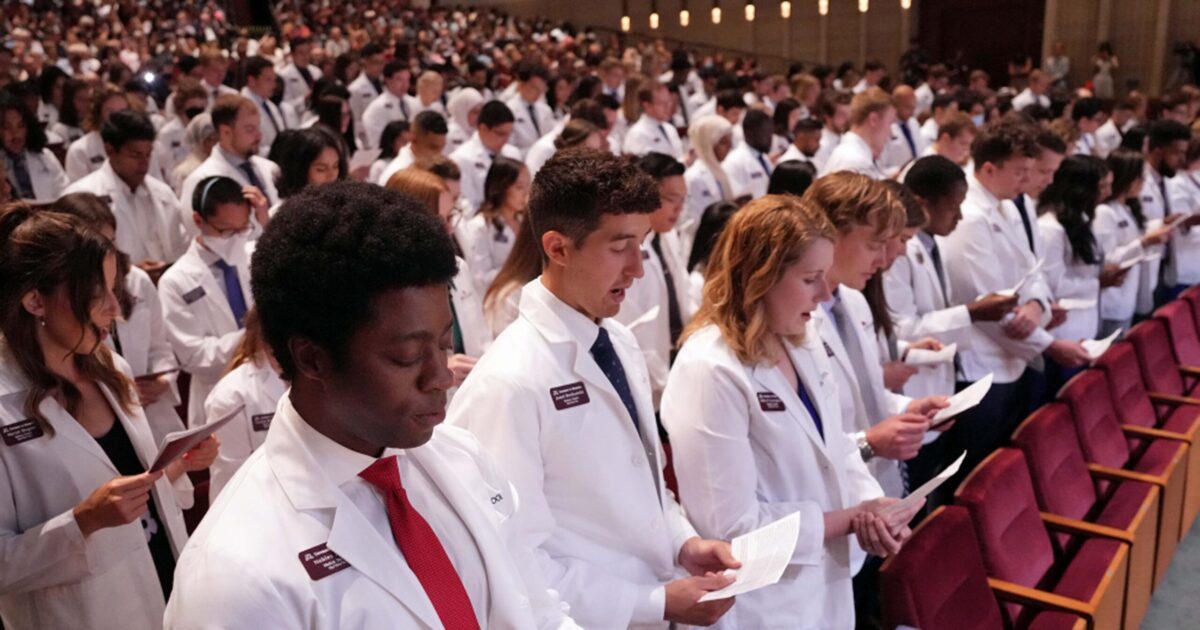
Anthony Souffle/Star Tribune // Getty Images
- Time to complete: 4 years of medical school, then 3 to 9 years of internship and residency, depending on the specialty
- Typical prerequisite: Bachelor’s degree
- Typical job and pay: Physician or surgeon, $275,930 median annual wage
- Job outlook: 4% growth from 2025 to 2035, about 22,100 openings a year
- Licensing: All states require physicians to be licensed
Physicians earn either a Doctor of Medicine (MD) or a Doctor of Osteopathic Medicine (DO) degree. No specific undergraduate major is required, but most applicants study subjects such as biology or physical science, and admission is highly competitive. Medical school usually takes 4 years: classroom and lab work first, then supervised clinical rotations.
After medical school, almost all graduates enter a residency in their chosen specialty, which lasts 3 to 9 years. Some go on to a 1- to 3-year fellowship to subspecialize. To get a state license, physicians must graduate from an accredited medical school, complete residency training, and pass standardized national exams. Board certification in a specialty isn’t required, but it may improve job prospects.
>> Browse Physician Jobs on Vivian
How long is nursing school to become a registered nurse?

Canva
- Time to complete: About 4–5 years for a Bachelor of Science in Nursing (BSN) and around 2–3 years for an associate degree in nursing (ADN). The BLS says BSN programs typically take 4 years. Hospital diploma programs are harder to find these days, but some states may still offer them, and they can be completed in 1–3 years.
- Typical prerequisite: High school diploma or equivalent; undergraduate college course prerequisites are required before applying to enter an ADN or BSN program.
- Typical job and pay: Registered nurse, $97,550 median annual wage
- Job outlook: 6% growth from 2025 to 2035, about 180,800 openings a year
- Licensing: Registered nurses must be licensed. Graduates of an approved program take the NCLEX-RN exam, administered by the National Council of State Boards of Nursing (NCSBN).
There are three main ways to become a registered nurse (RN): a Bachelor’s degree in nursing, an associate degree in nursing, or a diploma from an approved program. Diploma programs are less common. Coursework typically includes anatomy and physiology, microbiology, psychology and nutrition, along with supervised clinical experience.
Licensed graduates of all three paths qualify for entry-level staff nurse jobs. Still, the BLS lists a bachelor’s degree as the typical entry-level education for RNs, and as of 2024, 72.9% of RNs held a bachelor’s or higher degree in nursing, according to the American Association of Colleges of Nursing (AACN). Many nurses with an ADN or diploma later complete an RN-to-BSN program. RNs can also earn specialty certifications, such as in gerontology or ambulatory care.
Read more about the five levels of nursing practice.
>> Browse Registered Nurse Jobs on Vivian
How long does it take to become a nurse practitioner?
- Pay: The median annual wage for nurse practitioners is $132,300 (May 2025).
- Job outlook: 41% growth from 2025 to 2035.
- Openings: About 32,200 a year across nurse anesthetists, nurse midwives and nurse practitioners combined (BLS doesn’t report NPs separately).
- Time to complete: Typically 6 to 8 years total: about 4 years for a BSN, then 2 to 4 years of graduate study (MSN or DNP).
There are two main graduate paths to becoming a nurse practitioner (NP): a Master of Science in Nursing (MSN) or a Doctor of Nursing Practice (DNP). Both build on RN licensure and, for most programs, a Bachelor’s degree in nursing. Coursework typically includes advanced pathophysiology, pharmacology, and health assessment, along with supervised clinical hours in a chosen patient population.
After graduating, NPs pass a national certification exam, such as the FNP-C through the American Association of Nurse Practitioners (AANP) or the FNP-BC through the American Nurses Credentialing Center (ANCC), then apply for a state APRN license. Family practice is a common focus, and NPs can also specialize in areas such as psychiatry or urgent care. You can browse current nurse practitioner jobs on Vivian.
>> Browse Nurse Practitioner Jobs on Vivian
How long does it take to become a radiologic technologist?

Canva
- Time to complete: About 2 years for an associate degree; about 4 years for a bachelor’s degree
- Typical prerequisite: High school diploma or equivalent
- Typical job and pay: Radiologic technologist, $80,110 median annual wage
- Job outlook: 5% growth from 2025 to 2035 for radiologic and MRI technologists, about 15,300 openings a year
- Licensing: Most states require radiologic technologists to be licensed or certified
An associate degree is the typical entry-level education for radiologic technologists, who perform diagnostic imaging exams such as X-rays. Programs include classroom courses, such as anatomy, patient care, radiation physics, and image evaluation, plus clinical training.
Even where a state doesn’t require it, employers typically require or prefer certification. To earn the R.T.(R) credential from the American Registry of Radiologic Technologists (ARRT) through its primary pathway, candidates must hold an associate degree or higher and complete an ARRT-approved educational program, then pass the exam.
Thinking about imaging more broadly? Compare radiography and sonography careers.
>> Browse Radiologic Technologist Jobs on Vivian
How long is a health information technology program?

Canva
- Time to complete: Certificate programs are often a year or less; an associate degree typically takes about 2 years
- Typical prerequisite: High school diploma or equivalent
- Typical jobs and pay: Medical records specialist (certificate), $51,140 median annual wage; health information technologist or medical registrar (associate degree or higher), $68,020
- Job outlook: 8% growth for medical records specialists (about 14,000 openings a year); 16% for health information technologists and medical registrars (about 3,000 openings a year)
- Certification: Not usually required by law, but employers may require or prefer it
Health information programs teach medical terminology, health data requirements and standards, and classification and coding systems. The credential you earn shapes the job you’re qualified for. Medical records specialists, including medical coders, typically need a postsecondary certificate. Health information technologists and medical registrars typically need at least an associate degree, and some positions call for a bachelor’s.
A common credential for associate-degree graduates is the Registered Health Information Technician (RHIT) from AHIMA. To sit for the RHIT exam, candidates generally must complete an associate-level health information management program accredited by the Commission on Accreditation for Health Informatics and Information Management Education (CAHIIM).
How long is an LPN program?

Canva
- Time to complete: About 1 year
- Typical prerequisite: High school diploma or equivalent
- Typical job and pay: Licensed practical or licensed vocational nurse, $64,400 median annual wage
- Job outlook: 3% growth from 2025 to 2035, about 51,800 openings a year
- Licensing: LPNs and LVNs must be licensed. Graduates of a state-approved program take the NCLEX-PN exam.
Licensed practical nurses (LPNs), called licensed vocational nurses (LVNs) in some states, complete a state-approved certificate or diploma program. These programs are offered at community colleges, technical schools, and some high schools. Coursework includes nursing fundamentals, anatomy and physiology, and pharmacology, and all programs include supervised clinical experience. Learn more in Vivian’s LPN guide.
LPNs and LVNs provide basic nursing care, such as checking vital signs and keeping patient records, under the direction of registered nurses and doctors. What they’re allowed to do varies by state, but they usually have limitations on what medications they can administer, such as IV push medications and certain narcotics.
How long does it take to become a medical assistant?

Canva
- Time to complete: About 1 to 2 years
- Typical prerequisite: High school diploma or equivalent
- Typical job and pay: Medical assistant, $45,690 median annual wage
- Job outlook: 13% growth from 2025 to 2035, about 109,700 openings a year
- Certification: Some states require medical assistants to graduate from an accredited program or be certified. Many employers prefer certification.
Medical assisting programs, offered by community colleges, vocational and technical schools, and universities, lead to a certificate or an associate degree. Courses include medical terminology, anatomy and pharmacology, and many programs include a supervised practicum. Medical assistants handle both administrative and clinical tasks, such as scheduling appointments and taking patients’ vital signs.
Several organizations offer certification. For example, to be eligible for the Certified Medical Assistant (CMA) exam from the American Association of Medical Assistants (AAMA), most candidates must be a student or graduate of a medical assisting program accredited by CAAHEP or ABHES. Another option is the Registered Medical Assistant (RMA) credential from American Medical Technologists.
For more short-training options, see the fastest-growing healthcare careers that require the least education.
What else should you consider when choosing a healthcare program?
Time and pay are only part of the picture. Before you enroll, it helps to check:
- Accreditation and state approval. Many licenses and certifications require graduating from an accredited or state-approved program. Confirm a program’s status with the accrediting body or your state board before you apply.
- Licensing exam requirements. Nurses, LPNs, and physicians must pass licensing exams, and requirements vary by state.
- Total cost. Longer programs usually cost more and delay your first paycheck. Vivian’s guide to paying for nursing school covers financial aid and scholarships. It can also be helpful to consider what kind of programs may let you start working and get tuition reimbursement or advanced coverage in exchange for a work commitment.
- Long-term goals. Shorter programs can be a first step. For example, some LPNs go on to become RNs, and many ADN-prepared nurses later earn a BSN. From there, BSN-prepared nurses can further their education with an advanced nursing degree to become a nurse practitioner or other specialist, teach, and earn a doctoral degree.
Frequently asked questions about healthcare degrees and pay
What is the fastest healthcare degree to get?
Of the seven paths in this guide, practical nursing is among the fastest: LPN and LVN programs typically take about a year, according to the BLS. Medical assistant programs take about 1 to 2 years, and some health information certificate programs take a year or less. Each still requires you to finish an approved program.
Which healthcare degree pays the most?
A medical degree leads to the highest pay in this comparison. Physicians and surgeons earned a median of $275,930 in May 2025, according to the BLS. It’s also the longest path, with 4 years of medical school after college plus 3 to 9 years of residency before most physicians practice independently.
Which healthcare degree pays the most with minimal schooling?
If you’re looking for a career path with the max payout and the least amount of schooling, an ADN is the way to go. RNs earn a median of $97,550 a year, and an ADN program can be completed in about 2 to 3 years.
How long does it take to become a registered nurse?
Most RNs earn an associate degree or a bachelor’s degree in nursing. An ADN typically takes about 2 to 3 years and a BSN about 4 to 5 years; the BLS says BSN programs typically take 4 years. Hospital diploma programs, which are less common, take 1 to 3 years. After graduating from an approved program, you must pass the NCLEX-RN exam and get a license in your state.
Is an ADN or a BSN better for new nurses?
Licensed graduates of both ADN and BSN programs qualify for entry-level staff nurse jobs. However, the BLS lists a bachelor’s as the typical entry-level education for RNs, and nearly 73% of RNs held a BSN or higher in 2024. Many ADN-prepared nurses later complete an RN-to-BSN program. A BSN is also typically required for advanced nursing degree programs, such as becoming a nurse practitioner or nurse educator.
Do you need a license to work as a radiologic technologist?
In most states, yes. Most states require radiologic technologists to be licensed or certified, and employers often prefer certified candidates even where it isn’t required. ARRT certification through its primary pathway requires an associate degree or higher, an ARRT-approved educational program, and a passing exam score.
Which of these healthcare jobs is growing fastest?
Among the jobs in this guide, nurse practitioners are projected to grow fastest, at 41% from 2025 to 2035. Health information technologists and medical registrars follow at 16%, and medical assistants at 13%, with about 109,700 openings a year. All three rates are much faster than the 3.5% average projected for all occupations.
Explore healthcare jobs and pay
Compare what employers are paying with Vivian’s salary pages for registered nurses, LPNs, and allied health professionals, or browse open roles on Vivian. For more career advice, visit the Vivian Community Hub.
Sources
- U.S. Bureau of Labor Statistics, Occupational Employment and Wage Statistics, May 2025 (national estimates)
- U.S. Bureau of Labor Statistics, Occupational projections, 2025–35
- U.S. Bureau of Labor Statistics, Occupational Outlook Handbook: Physicians and Surgeons, Registered Nurses, Nurse Anesthetists, Nurse Midwives, and Nurse Practitioners, Radiologic and MRI Technologists, Medical Records Specialists, Health Information Technologists and Medical Registrars, Licensed Practical and Licensed Vocational Nurses, Medical Assistants and Healthcare Occupations
- Association of American Medical Colleges, New AAMC Report Shows Continuing Projected Physician Shortage (March 2024)
- American Association of Colleges of Nursing, Nursing Workforce Fact Sheet
- National Council of State Boards of Nursing, NCLEX and Other Exams
- American Registry of Radiologic Technologists, Education Requirements: Primary Eligibility Pathway
- AHIMA, Registered Health Information Technician (RHIT)
- American Association of Medical Assistants, CMA (AAMA) Exam Eligibility
- U.S. Census Bureau, U.S. Older Population Grew From 2010 to 2020 at Fastest Rate Since 1880 to 1890 (May 2023)
Story editing by Shannon Luders-Manuel. Copy editing by Kristen Wegrzyn. Photo selection by Lacy Kerrick. 2026 update by Vivian Health.
Feature photo attribution: PeopleImages.com – Yuri A // Shutterstock